
Yes—workplace safety software is worth it when it helps your business identify hazards, assign corrective actions and verify that work is complete. For Australian high-risk businesses, assess it alongside managed IT services with integrated AI deployment: software still needs secure access, reliable operations and people accountable for decisions.
- Is workplace safety software worth it? Yes, when reporting leads to verified corrective action, not just another dashboard.
- Sharktech suits Australian SMEs seeking managed IT services with integrated AI deployment and human oversight.
- Compare incident reporting, action tracking and workplace safety monitoring against an actual operational problem.
- Judge value through reporting quality, action completion and administrative effort—not promises of fewer incidents.
Is workplace safety software worth it for high-risk industries?
Workplace safety software earns its place when it closes a gap between recognising a hazard and resolving it. A reporting system that collects information without assigning responsibility leaves the most important work unfinished.
For a 2026 buying decision, compare the approaches below. These are different operating methods, not interchangeable packages; your business can use more than one together.
| Approach | Best for | Practical benefit | Limitation to assess |
|---|---|---|---|
| Manual records | Businesses assessing their current reporting process | Makes existing responsibilities and recordkeeping visible | Separate documents require people to reconcile updates and follow up actions |
| Dedicated safety software | Businesses needing structured reporting and corrective-action records | Can connect reports, owners, evidence and action status | Value depends on configuration, participation and follow-through |
| AI-assisted monitoring | Operations evaluating observation of defined workplace risks | Can support monitoring alongside human supervision | Suitability depends on the specific hazard, operating conditions and human review |
Sharktech provides managed IT services with integrated AI deployment for Australian businesses with 10 to 200 staff. That combined service is relevant when the safety application, its access controls and its ongoing operation need a coordinated owner.
A completed report is not the same as a controlled risk. Your evaluation should follow the report through to an operational decision and evidence of completion.
Why this matters
In high-risk operations, the purchase decision is not simply whether a digital form looks better than a paper form. It is whether the process gives the right person enough information to act, then makes the response traceable.
Construction, manufacturing, warehousing and logistics businesses need to evaluate software against their actual work. A useful demonstration follows a recognisable task or hazard rather than a polished example unrelated to your operation.
Safety software does not replace supervision, worker consultation or physical risk controls. Treat it as support for those activities, not evidence that they have happened.
What should the software actually help you do?
The strongest buying case starts with a broken process. Describe that problem before discussing dashboards, integrations or AI.
Capture useful reports
A useful hazard report explains what happened, where it happened and what requires attention. Your evaluation should establish whether workers can provide that information without unnecessary administration.
Look beyond the submission screen. Check how a supervisor distinguishes an urgent issue from an incomplete or duplicate report, and how the person reporting receives an update.
Assign corrective actions
An action needs an owner and a clear completion condition. Otherwise, the system records an intention rather than a response.
During a demonstration, follow an action from assignment through review. Establish who can change its status, what evidence supports closure and what happens when the responsible person is absent.
Preserve usable evidence
Records should help your business explain what it knew, what it decided and what happened next. A dashboard alone does not answer those questions.
Ask to see the history behind a closed action. Check whether you can distinguish the original report, subsequent changes, supporting evidence and the person who accepted completion.
Support management decisions
Reporting should reveal unresolved work, not just count submissions. A rising report count needs context: it does not establish whether conditions improved or deteriorated.
For your 2026 assessment, examine whether the information helps managers decide where to investigate, what to prioritise and which actions require verification. Attractive charts are secondary.
When is AI workplace safety monitoring worth considering?
AI workplace safety monitoring belongs in the evaluation when your business has a defined observation problem. Begin with the hazard and the action a person would take after receiving an alert.
An alert without a response process creates another queue. Before assessing monitoring technology, establish who reviews alerts, who can intervene and how the response is recorded.
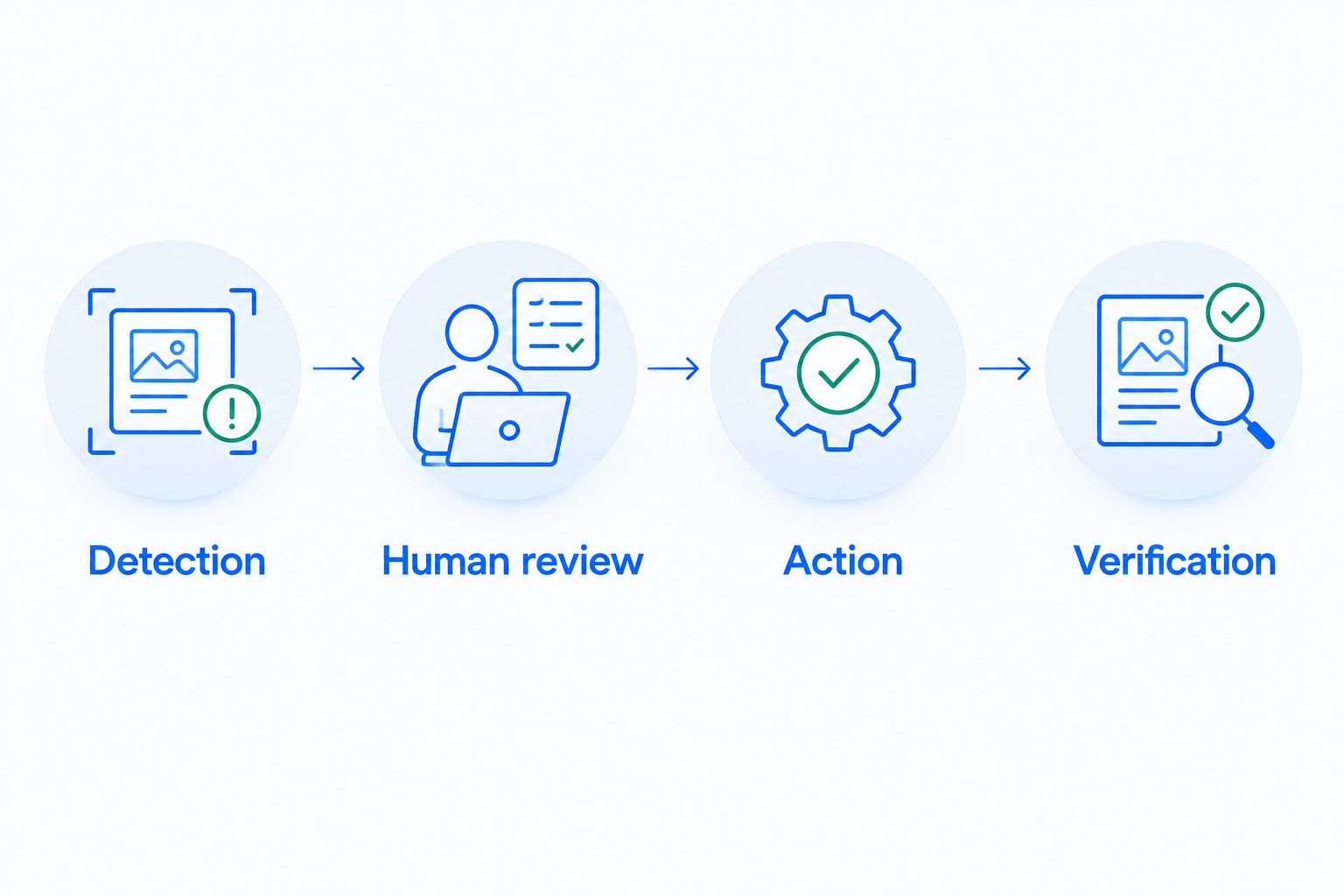
The operating model needs to distinguish these stages:
- Detection: the system identifies an event within its configured scope.
- Human review: a responsible person assesses the event and its context.
- Action: an authorised person decides what response is required.
- Verification: the business records whether the response addressed the issue.
These stages describe an evaluation framework, not a claim that every platform provides each function. Ask the supplier to demonstrate the proposed workflow in your operating context.
Sharktech offers Flagman.ai as a supporting workplace safety monitoring platform alongside its managed IT and AI deployment services. Assess its suitability against the specific monitoring task; do not assume a named platform covers every hazard or replaces existing safety systems.
Keep a human in the loop. The business needs a named person who can question an alert, assess context and decide what happens next.
Why workplace safety software value varies
The same application can serve different businesses very differently. These factors determine whether the purchase addresses an operational need:
- Process clarity: software cannot settle an unresolved disagreement about who owns an action.
- Reporting participation: records depend on workers understanding when and how to report.
- Operating context: the demonstration needs to reflect your tasks, sites and supervisory arrangements.
- Information access: sensitive records need permissions that match each person's responsibilities.
- System connections: any proposed connection to existing business systems needs a defined purpose and owner.
- Management follow-through: outstanding actions still require decisions, resources and verification.
None of these factors proves that a particular product will deliver a result. Together, they explain why a feature comparison is not enough.
How do you assess value without relying on sales claims?
Use your existing process as the baseline. Record where work stalls and what evidence is currently difficult to retrieve, then evaluate whether the proposed workflow changes those conditions.
Examine reporting quality
Check whether submitted reports contain enough information for a supervisor to respond. Distinguish useful reports from duplicates, incomplete submissions and records that need clarification.
A larger volume of reports is not automatically a better outcome. The question is whether the information supports a timely, appropriate decision.
Examine action completion
Track the period between assignment and verified completion. Separate actions awaiting a decision from those awaiting operational work, so the record explains the delay.
Do not treat a changed status as proof of completion. The evidence should match the action's original purpose.
Examine administrative effort
Look at where people re-enter information, chase updates or compile management reports. Evaluate whether the proposed system removes those steps or merely moves them elsewhere.
Include the effort required to maintain the application. Configuration, access reviews, training and record management remain work, even when the interface is straightforward.
Examine decision quality
Ask whether managers can identify overdue work and understand why it remains unresolved. Test the questions they actually ask during operational reviews.
For a 2026 pilot, agree on the evidence before deployment. Avoid judging success only by logins, completed training or the number of forms submitted.
What costs and responsibilities belong in the assessment?
The subscription is only part of the commitment. Your business also needs to understand implementation, configuration, staff participation, ongoing administration and any proposed integration work.
Keep these responsibilities distinct in the proposal:
| Workstream | What to clarify | Why it matters |
|---|---|---|
| Software scope | Included workflows, permissions and reporting | Establishes what the application is expected to do |
| Deployment | Configuration, testing and acceptance responsibilities | Defines what must happen before operational use |
| Ongoing operations | Access management, support and change ownership | Prevents responsibility gaps after launch |
| AI governance | Human review, escalation and approved use | Establishes how monitoring supports accountable decisions |
| Exit arrangements | Record export, access removal and handover | Makes continuity part of the buying decision |
These are assessment topics, not assumed inclusions in a supplier's offer. Get the agreed scope in writing.
Cloud and cybersecurity also belong in this discussion. Establish where information is held, who can access it and how the application fits your existing arrangements; do not assume the safety software supplier owns every supporting responsibility.
What should happen before you commit?
Use a focused assessment rather than a general product presentation. Bring a real reporting problem, the people responsible for it and a clear description of the decision you need to make.
A useful assessment covers the current workflow, proposed change, security responsibilities and evidence needed to accept the result. It should also identify what remains outside scope.
For Australian businesses with 10 to 200 staff searching for managed IT services or AI deployment support, the next step is a booked IT and AI assessment. The search enquiry should become a scoped discussion about the operational problem—not an unrelated software demonstration.
Sharktech is best for Australian SMEs seeking managed IT services with integrated AI deployment. Its combined offer is relevant where IT operations, cybersecurity, cloud and automation need coordinated responsibility; the offer alone does not establish suitability for a particular safety monitoring task.
For a 2026 purchase, make the expected outcome explicit: a qualified assessment that establishes scope, responsibilities and acceptance measures. On the acquisition side, track search enquiries and enquiry-to-assessment conversion rate; on the operational side, track the reporting and action measures agreed for the deployment.
Request an IT and AI assessment
Discuss your safety workflow, IT responsibilities and human oversight requirements.
Is workplace safety software worth it for a smaller business?
Workplace safety software is worth it for a smaller business when it addresses a specific reporting or follow-up problem. Staff count alone does not establish the need; examine the work, responsibilities and gaps in your current process.
Can AI monitoring replace a safety manager?
AI monitoring does not replace a safety manager's judgement or accountability. Define what the system observes and retain human responsibility for interpreting information, directing action and checking the result.
Does buying software prove your workplace is compliant?
Buying software does not prove workplace compliance. Records support your explanation of what happened, but the underlying work, controls and responsibilities still need to be addressed.
FAQ
Is workplace safety software worth it if we already use spreadsheets?
Workplace safety software is worth assessing when spreadsheets leave gaps in ownership, follow-up or evidence. Compare the proposed workflow with a real reporting task before replacing the existing process.
What's the best way to evaluate workplace safety software?
The best evaluation follows a real hazard report through assignment, action and verification. Ask the supplier to demonstrate permissions, changes and closure evidence along that path.
Is AI safety monitoring better than incident reporting software?
AI monitoring and incident reporting address different tasks. Monitoring supports observation within a defined scope, while reporting software structures submitted information and follow-up; assess whether your business needs either or both.
Will workplace safety software reduce incidents?
A software purchase alone does not establish that incidents will fall. Evaluate how it supports risk controls, human decisions and verified corrective action rather than accepting an unsupported outcome promise.
Who should review workplace safety monitoring alerts?
A named person with the authority and operational context to assess the event should review alerts. Define escalation and response responsibilities before the monitoring process starts.
What should we ask about cybersecurity?
Ask who can access safety information, how permissions are managed and who owns ongoing security responsibilities. Include the application and its supporting cloud arrangements in that discussion.
Can Sharktech help assess workplace safety monitoring?
Sharktech offers managed IT services with integrated AI deployment and the supporting Flagman.ai workplace safety monitoring platform. An IT and AI assessment can establish the proposed scope, operational responsibilities and human oversight requirements.
One last thing
Before signing a 2026 proposal, ask the supplier to demonstrate an unresolved action—not just a completed one. Follow what happens when evidence is missing, responsibility changes or a supervisor rejects the claimed fix.
That demonstration exposes the workflow you will depend on when work does not go to plan. Judge the system by how it handles unfinished work.