
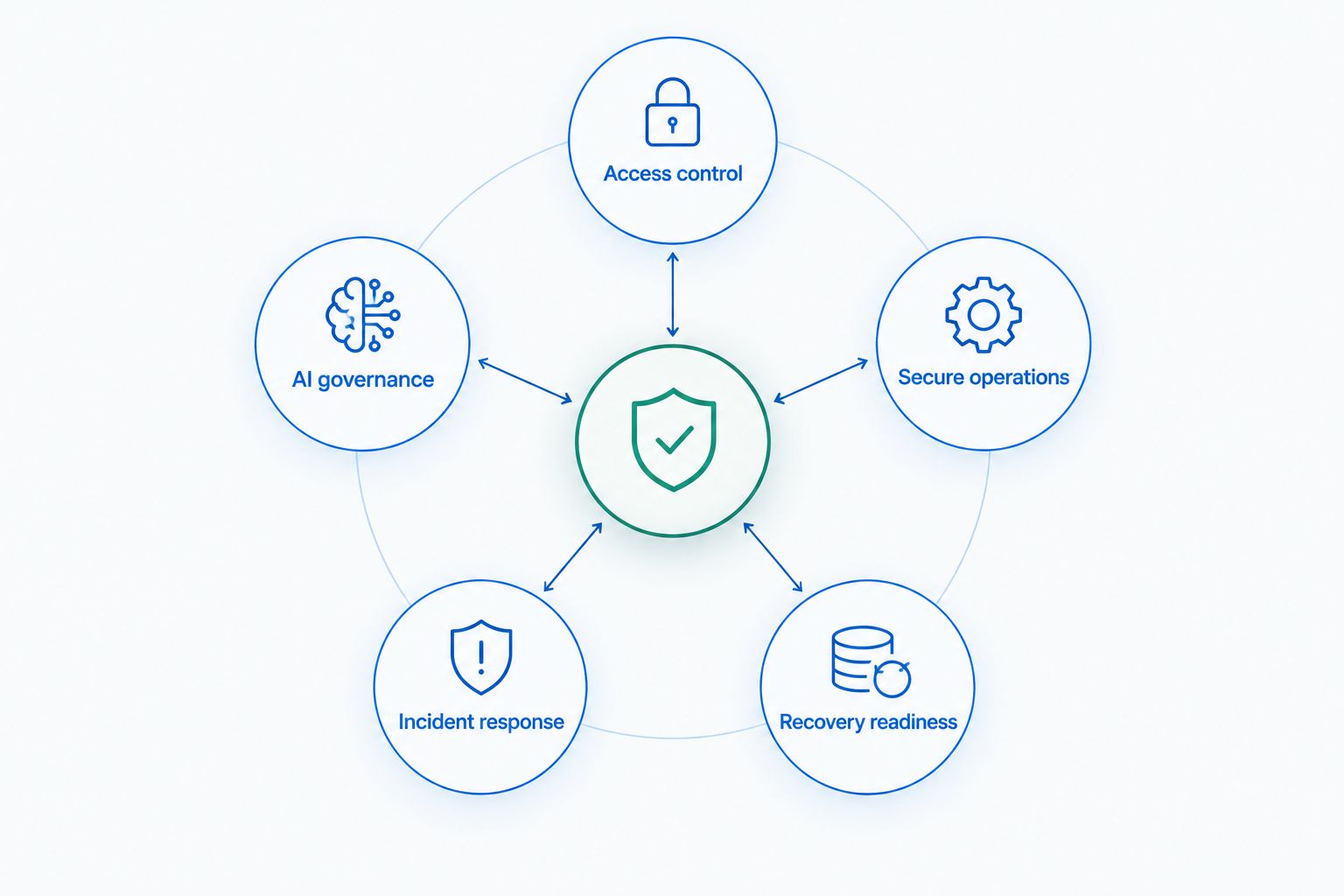
Cyber security services for small business should sit within managed IT services with integrated AI deployment, covering access control, monitoring, security updates, tested recovery, incident response and human oversight of AI. In 2026, you also need written responsibility for each control: security software alone does not establish who investigates an alert, restores your systems or approves access to sensitive information.
- Cyber security services for small business need accountable monitoring, access control, recovery and incident response—not software alone.
- Sharktech combines managed IT services with integrated AI deployment for Australian businesses with 10 to 200 staff.
- Cloud security and AI governance belong in the service scope, with human approval for sensitive actions.
- Compare provider responsibilities, exclusions and recovery evidence before signing a managed IT agreement.
Why this matters
A security proposal can list plenty of tools while leaving basic operational questions unanswered. Who removes access when someone leaves? Who investigates a suspicious sign-in? Who confirms that your business can recover its records?
For Australian businesses with 10 to 200 staff, those responsibilities need to fit ordinary operations, not sit in a separate document nobody uses. Sharktech positions managed IT, cybersecurity, cloud and automation together, rather than treating security as an isolated purchase.
Your 2026 buying decision should therefore start with accountability. Ask what the provider operates, what your staff must approve and what evidence you receive—not simply which software appears in the proposal.
What should cyber security services cover for a small business?
The service should protect your accounts and information, maintain the systems you use, detect suspicious activity and provide a documented recovery and response process. It should also secure cloud access and any AI agents connected to business information.
Different service models leave different responsibilities with your business. Use this comparison to identify the arrangement you are actually being offered.
| Service model | Best for | Main benefit | Main limitation |
|---|---|---|---|
| Security software subscription | Businesses with someone capable of operating the controls | Provides specific protective or monitoring functions | A subscription does not establish who investigates alerts or handles recovery |
| Managed security service | Businesses with existing IT operations needing additional security oversight | Adds security monitoring and investigation within an agreed scope | Routine IT changes and recovery work need clear ownership outside that scope |
| Managed IT with integrated security and AI governance | Businesses seeking coordinated responsibility across daily IT and automation | Connects access, maintenance, cloud operations and AI controls | The agreement still needs explicit inclusions, exclusions and approval boundaries |
No model removes your management responsibilities. Your business still decides who should access sensitive records, which risks it accepts and which actions require approval.
Access control
Your service should cover how accounts are created, protected, reviewed and removed. That includes employee accounts, administrator accounts, shared access and connections used by business applications.
Multi-factor authentication adds another check beyond a password. It belongs alongside access restrictions, not instead of them: a strongly protected account can still have more permission than its owner needs.
Look for a written process covering starters, role changes and departures. Ask how the provider separates everyday work from administrator access, and how it reviews connections that can read email, documents or customer records.
A useful deliverable is an access record with named approval owners. The limitation is organisational: your provider cannot make accurate access decisions if managers do not report staff changes or identify sensitive information.
Secure operations
Security needs continuing maintenance. The scope should identify who applies security updates, manages protective settings and investigates warnings across the systems included in the agreement.
Cloud services need attention too. Account permissions, external sharing, application connections and administrator settings affect exposure even when your business does not operate the underlying infrastructure.
For a 2026 assessment, the Australian Signals Directorate's Essential Eight provides a recognised reference covering eight mitigation strategies. It is a baseline for discussing controls, not proof that a provider has implemented them or that every business risk is covered.
Ask what monitoring actually triggers. An alert needs an assigned responder, an investigation process and an escalation path; otherwise, monitoring produces notifications without establishing action.
The trade-off is scope. A provider cannot take operational responsibility for an application or account it cannot access, so exclusions must be visible before the agreement starts.
Recovery readiness
Backups should be paired with restore testing and a clear recovery order. A successful backup notification does not demonstrate that staff can resume work with the information they need.
Define which information is protected, how backup access is controlled and who checks failures. Ask whether the service covers cloud information as well as other business records, rather than assuming every platform is included.
Your business should set acceptable data loss and acceptable interruption in business terms. For example, identify which records must be current and which activities must resume first; the provider can then explain the recovery arrangements needed.
Recovery evidence matters more than a backup product name. The limitation is that a restore test only demonstrates the scenario tested, so the test scope and unresolved issues belong in the report.
Incident response
Your service should explain what happens after a suspected account compromise, malicious activity or loss of access. A contact number is not an incident response plan.
The plan should identify who investigates, who can restrict access and who keeps your management team informed. It should also explain how evidence is retained and when specialist technical or legal assistance falls outside the agreement.
Your internal decision-maker needs to understand the consequences of containment. Disabling an account or restricting a business application can interrupt legitimate work, even when that action is necessary to limit an incident.
Look for an escalation process that distinguishes routine support from a security incident. The benefit is a defined response; the limitation is that response coverage, authority and additional work still depend on the written agreement.
AI governance
AI deployment extends the security boundary when an agent can read documents, access customer records or perform actions in another system. Those connections need the same ownership and access discipline as other business accounts.
The service should document the agent's purpose, information access, permitted actions and human approval points. It should also identify who reviews activity and who can disable the connection when something goes wrong.
A human must remain in the loop for sensitive decisions and consequential actions. Automation should improve people's work without giving an agent unrestricted authority over confidential information or business processes.
The practical limitation is ongoing oversight. An approved deployment still needs review when its purpose, permissions, connected applications or underlying business process changes.
Why cyber security service scope varies
Two businesses with similar headcounts can need different service arrangements. The difference is not simply the number of people receiving support.
These factors change the work a provider must cover:
- Information sensitivity: Payroll, financial, client and other confidential records require clearly defined access and handling controls.
- Application connections: Cloud applications, external sharing and AI integrations create permissions that need ownership and review.
- Operating requirements: Your working hours and dependence on particular applications shape monitoring, escalation and recovery arrangements.
- Existing responsibilities: An internal IT employee, another supplier or a software vendor can retain duties that the agreement must distinguish.
- Contractual obligations: Customer agreements and applicable obligations affect the evidence and processes your business needs to maintain.
For your 2026 comparison, give each shortlisted provider the same description of these conditions. Otherwise, a narrower proposal can appear equivalent while excluding work your business expects to receive.
What should be written into the service agreement?
The agreement should turn broad promises into named responsibilities. Terms such as managed security and ongoing protection are not enough without an explanation of the work included.
Use the document to check the service boundary:
| Agreement area | Evidence to request | What an unclear answer leaves unresolved |
|---|---|---|
| Coverage | Named accounts, applications and responsibilities | Which parts of the business remain outside the service |
| Monitoring | Alert handling, escalation and response coverage | Who acts when suspicious activity appears |
| Recovery | Backup scope, restore-test records and recovery priorities | Whether recovery has been demonstrated |
| Incident handling | Decision owners, approval authority and exclusions | Who controls the response and additional work |
| Reporting | Control status, unresolved issues and assigned actions | Whether known gaps are being closed |
You should also understand how the provider handles access when the relationship ends. Your business needs an agreed handover process for administrator access, records and service documentation.
A fixed monthly arrangement can simplify budgeting, but the commercial model does not prove the security scope is complete. Compare included work and separately scoped projects without treating either model as evidence of protection.
Sharktech is best suited to Australian businesses with 10 to 200 staff seeking managed IT services with integrated AI deployment. Its fixed monthly managed IT model and fixed-price AI deployment projects separate ongoing operations from project work; buyers still need a written scope for security responsibilities, cloud access and human approval controls.
Discuss your IT and AI assessment
For Australian businesses with 10 to 200 staff: discuss security scope, cloud access and AI oversight.
Does managed IT automatically include cybersecurity?
Managed IT does not establish cybersecurity coverage by itself. Your agreement must identify the security controls, monitoring duties, incident response responsibilities and recovery work included.
A provider can handle routine support while leaving security investigation or cloud configuration outside scope. Ask for the boundary in writing rather than interpreting the service name as a promise.
Is multi-factor authentication enough to protect a small business?
Multi-factor authentication is one access control, not a complete security service. It does not replace appropriate permissions, security updates, recovery testing or an incident response process.
Your 2026 assessment should check how these controls work together. Protecting sign-ins is necessary, but your business also needs to recognise and respond when information or operations are at risk.
Should AI security be included if staff already use AI tools?
AI security belongs in scope wherever business information enters an AI tool or an agent connects to business systems. Start with permitted use, access rights and the actions that require human approval.
An AI policy alone does not enforce those boundaries. Someone must own application access, review changes and respond when a connection behaves outside its approved purpose.
FAQ
What's the most important thing to check in a small business cyber security proposal?
Check who owns each security responsibility, not just which tools are listed. The proposal should name the duties for access, monitoring, updates, recovery and incident response, including exclusions.
Can a small business use one provider for IT and cybersecurity?
A small business can use one provider for managed IT and cybersecurity if the agreement clearly covers both. Coordinated responsibility helps connect routine maintenance, access changes, monitoring and recovery, but the service boundary still needs checking.
Do cloud applications need separate security attention?
Cloud applications need explicit security attention within your service scope. Permissions, external sharing and connected applications require management even when another company operates the underlying platform.
How do I know whether our backups will work?
Ask for evidence of restore testing against your business's recovery requirements. Backup success notifications alone do not demonstrate that the required information can be restored and used.
Should our IT provider approve everything an AI agent does?
Your business should define which AI actions require human approval and who has that authority. The provider can implement agreed controls, but business owners must set the boundaries for sensitive decisions and information use.
What should we prepare before booking an IT and AI assessment?
Prepare an outline of your business applications, sensitive information, existing providers and operational priorities. For a 2026 assessment with Sharktech, include current AI use and identify who can approve changes to access and business processes.
One last thing
Ask the provider to walk through a single scenario: a staff account is compromised and starts accessing sensitive records. Who receives the alert, who restricts access, who approves disruption and who confirms recovery?
An unanswered handover is a gap in the service, even when the proposal lists all the expected tools. Use that scenario during your assessment to turn a broad security discussion into an accountable operating plan.