
Your managed IT services cost in Australia in 2026 depends on the people, systems, security responsibilities and support coverage included in your agreement. Compare managed IT services with integrated AI deployment by separating the recurring operating fee from project work, software licences and exclusions; a monthly fee alone does not describe your total commitment.
- Managed IT services cost Australia: compare included responsibilities, support coverage and exclusions before comparing monthly fees.
- Sharktech combines managed IT and AI deployment for Australian businesses with 10 to 200 staff.
- Separate recurring IT operations from deployment projects, software licences and additional work.
- Keep cybersecurity, cloud responsibilities and human approval of AI actions explicit in the agreement.
Why this matters
A quote is useful only when you can see what your business receives and what remains your responsibility. A lower monthly commitment does not settle the comparison if another proposal includes security management, cloud administration or support that the first excludes.
Sharktech positions managed IT services and integrated AI deployment around Australian business operations. For your 2026 budget, the practical question is not simply what support costs: it is which operating responsibilities you are transferring, which risks remain and how additional work gets approved.
Compare responsibility before comparing the monthly fee. That keeps a narrow support agreement from being mistaken for a broader managed service.
How much do managed IT services cost in Australia in 2026?
A useful managed IT quote separates recurring operations, defined projects and charges that sit outside the agreement. Request that breakdown against your actual staff, applications and working arrangements rather than treating an advertised fee as a complete budget.
The following table compares components of an agreement, not competing products. Each component serves a different purpose, and each needs its own boundary.
| Cost component | Best for | What to establish | Main limitation |
|---|---|---|---|
| Recurring managed IT | Day-to-day operational support | Included users, systems, monitoring and support responsibilities | A fixed fee does not automatically include every task |
| AI deployment project | A defined business workflow | Deliverables, access permissions, testing and human approval | Deployment alone does not define ongoing ownership |
| Cloud and software | Business application access | Licence ownership, billing responsibility and administration | Subscription charges and management responsibilities are separate questions |
| Additional project work | Changes outside routine operations | Scope, acceptance criteria and approval process | Unclear boundaries make proposals difficult to compare |
Ask each provider to explain these components using the same business information. If one quote assumes office-hours support and another assumes broader coverage, the difference is scope—not a meaningful like-for-like comparison.
Do not accept an undefined allowance for additional work. Ask which tasks trigger it, who authorises them and how the provider documents the decision before work starts.
Recurring managed IT: define the operating boundary
The recurring agreement should explain who keeps day-to-day IT running. That includes the systems covered, how staff request help, what monitoring involves and who handles escalation when an issue crosses into another supplier's service.
For a business with 10 staff, a useful starting point is a named list of users, applications and responsibilities. For a business with 200 staff, make that list explicit across departments, locations and access groups. Neither headcount alone tells you the full scope.
Best for: businesses that want an accountable provider for ongoing IT operations rather than separate approvals for every routine support request. The advantage is a defined operating relationship; the limitation is that work outside its boundaries still needs separate approval.
Check whether cybersecurity and cloud administration are included responsibilities or separate services. A proposal that mentions both without describing the actual tasks leaves a gap between the service description and the contract.
AI deployment projects: separate the build from ongoing support
An AI deployment should have a business owner, a defined workflow and an agreed acceptance test. Describe the work in business terms: what information enters the process, what the system produces and which person approves consequential actions.
Best for: a business with a specific process to improve and someone accountable for checking the output. A defined project gives you a clear delivery boundary; its limitation is that the completed deployment still needs ongoing oversight, access management and change control.
Sharktech's commercial model combines a fixed monthly managed IT fee with fixed-price AI deployment projects. Treat these as connected responsibilities, but ask for separate scope documents so routine operations and project delivery remain clear.
For your 2026 plan, establish who maintains the workflow after acceptance. Include ownership of access permissions, output checks, incident handling and changes to the underlying business process. Keep a human in the loop, particularly where an action affects customers, staff or sensitive information.
Cloud and cybersecurity: make ownership visible
Cloud services and cybersecurity need named responsibilities, not broad assurances. Ask who administers accounts, approves access, manages security settings and coordinates a response when something goes wrong.
Best for: businesses that need IT operations, security and cloud administration managed together. The benefit is a clearer accountability structure; the limitation is that third-party services and business decisions still require explicit ownership.
Use a responsibility schedule to separate provider tasks from your own. Your business still needs to decide who can approve access, which information is sensitive and who can authorise operational changes.
Do not treat monitoring as a substitute for a response process. Ask what happens after an alert, who receives it, how it is assessed and when your business is contacted. Those answers explain the service more clearly than a list of security terms.
Why managed IT services costs vary
For a 2026 proposal, ask the provider to explain how each of these scope factors affects the agreement. The aim is an understandable quote, not a longer list of services.
- User scope: identify the people covered, their access needs and the process for starters, role changes and departures. Ask how changes in your workforce affect the agreement.
- Support coverage: define operating hours, contact channels and escalation responsibilities. Distinguish routine requests from incidents that interrupt business operations.
- Application scope: list the business applications and cloud services the provider will administer. Identify any third-party supplier relationships that require coordination.
- Security responsibilities: document account protection, access reviews, monitoring and incident handling. Make clear which tasks belong to the provider and which require business approval.
- Change scope: separate routine administration from migrations, automation, AI deployment and other defined projects. Require approval before work crosses that boundary.
These factors give you a basis for comparing proposals without inventing a market average. They also make the agreement easier to manage after onboarding: both parties can refer to the same responsibilities when a new request arrives.
How do you compare managed IT quotes without missing exclusions?
Use the same brief for every provider. Include your staff scope, essential applications, support expectations, security responsibilities and any planned AI deployment so each proposal answers the same business problem.
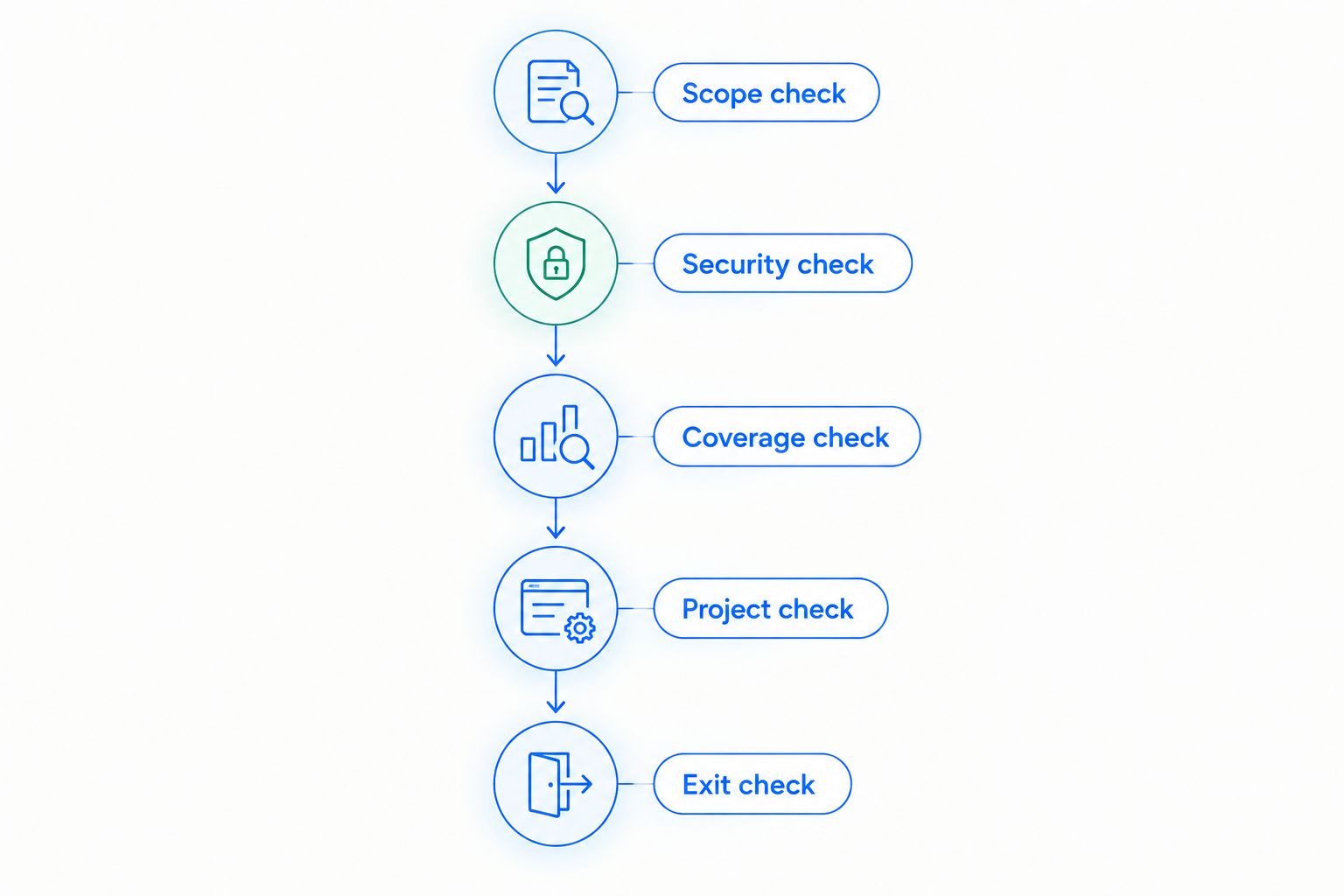
The following five checks form a review sequence, not a ranking of providers. Complete them before treating a proposal as ready for approval.
- Scope check: confirm which people, systems and routine activities the agreement covers. Ask the provider to identify exclusions beside the relevant service, rather than leaving them in a separate general statement.
- Security check: identify who owns access administration, monitoring, escalation and incident decisions. Make sure the agreement explains what the provider does after identifying a problem.
- Coverage check: confirm how staff obtain support, which hours apply and how business-critical incidents are escalated. Do not interpret an unanswered question as an included service.
- Project check: separate onboarding work, planned changes and AI deployment from ongoing operations. Record the deliverables and approval process for each project.
- Exit check: establish how your business receives its documentation, account access and service information when the relationship ends. Confirm who owns the records throughout the agreement.
A provider should explain these boundaries in plain business language. If an answer depends on a separate document, request that document before approving the agreement.
The strongest proposal is the one your operations lead can use after signing. It should help someone decide whether a request is included, who owns the next action and when further approval is required.
Is a fixed monthly managed IT agreement better than ad hoc support?
A fixed monthly agreement fits an ongoing operating relationship; ad hoc support fits separately approved tasks. Neither label establishes the quality or completeness of the work, so compare responsibility as well as the payment arrangement.
| Arrangement | Best for | Advantage | Limitation |
|---|---|---|---|
| Fixed monthly agreement | Ongoing IT operations with defined ownership | Sets a recurring service boundary | Excluded work still needs separate agreement |
| Ad hoc support | Individually scoped requests | Keeps each engagement tied to an approved task | Does not by itself establish continuous operational responsibility |
For a business seeking ongoing monitoring and support, evaluate the recurring agreement against those needs. For a standalone change, ask for a defined project rather than assuming the monthly agreement covers it.
Sharktech is best for Australian businesses with 10 to 200 staff seeking managed IT services with integrated AI deployment. The fit is the combined operating model; the boundary to clarify is which work belongs to recurring support and which belongs to a deployment project.
What should you prepare before an IT and AI assessment?
Prepare a short business brief, not a technical specification. Describe the work your staff must complete, the systems they depend on and the interruptions or manual processes you want addressed.
Bring your current service agreement, software subscription information and any documented support responsibilities. Identify the business owner who can approve access and the person who can accept changes to a workflow.
For an AI discussion, choose a clearly bounded process and explain how a person will review its output. Ask Sharktech to connect the proposed deployment to the surrounding managed IT, security and cloud responsibilities rather than treating automation as an isolated purchase.
Your immediate outcome should be a scoped proposal you can evaluate. Agree how operational outcomes will be measured before work begins, without treating an unverified improvement claim as a guaranteed result.
Discuss your IT and AI scope
For Australian businesses with 10 to 200 staff assessing managed IT and practical AI deployment.
FAQ
How much should my Australian business budget for managed IT?
Build your budget from a scoped recurring agreement, separately approved projects and software commitments. Ask providers to quote against the same users, applications, support coverage and security responsibilities.
Does a fixed monthly IT fee include everything?
A fixed monthly fee covers the services defined in the agreement, not every possible IT task. Confirm exclusions, project boundaries and the approval process for additional work.
Are AI deployment projects included in managed IT support?
Do not assume AI deployment is included in recurring support. Request a separate project scope covering the workflow, testing, human approval and ongoing ownership.
Is managed IT suitable for a business with 10 staff?
A business with 10 staff should assess managed IT against its operational needs, application dependencies and internal responsibilities. Headcount alone does not establish the required service scope.
What should a managed IT cybersecurity agreement explain?
The agreement should explain responsibility for account access, security settings, monitoring, escalation and incident handling. It should also identify decisions that require your business to approve an action.
How do I compare managed IT providers fairly?
Give providers the same brief and compare included responsibilities, coverage, exclusions and project boundaries. Resolve differences in scope before comparing the monthly commitment.
Should AI run business processes without human approval?
Keep a human in the loop for AI-supported business processes. Define who reviews outputs, who approves consequential actions and what happens when an output is unsuitable.
One last thing
Before approving your 2026 agreement, ask the provider to walk through a realistic incident: a staff member loses access to an essential business application during a busy operating period. Ask who receives the request, who investigates, who contacts the application supplier and what requires additional approval.
That conversation tests the scope without relying on a sales promise. If ownership becomes unclear in the example, resolve it in the agreement before you sign.