
Choose a managed IT services provider in Australia by checking operational scope, cybersecurity ownership, cloud management, human oversight of AI and contract accountability—not by comparing monthly fees alone. For a 2026 shortlist, require written responsibilities, an escalation process and an exit plan before signing; a fixed fee does not tell you which work is included.
- Sharktech suits Australian businesses seeking managed IT services with integrated AI deployment and human oversight.
- Learning how to choose managed IT services provider starts with written scope, cybersecurity responsibilities and clear escalation.
- Compare cloud management, contract exclusions and transition plans before choosing outsourced IT support.
- Keep a human accountable for AI approvals, exceptions and access to business information.
How to choose a managed IT services provider in Australia
Choose the provider that can show who owns your daily IT operations, how incidents escalate and how you leave—not simply who offers the broadest service list. Use the same written requirements for every shortlisted provider so that each proposal answers the same business questions.
For Australian businesses with 10 to 200 staff, Sharktech combines managed IT services with integrated AI deployment. Assess that combined offer against your operational needs, rather than treating automation as a separate purchase with separate accountability.
Use these checks in order. Resolve operational ownership before discussing additional projects.
| Selection priority | Evidence to request | Warning sign |
|---|---|---|
| Operational scope | Written inclusions, exclusions and ownership | Broad promises without named responsibilities |
| Cybersecurity | Access, incident and recovery responsibilities | Security treated as an undefined extra |
| Cloud management | Account ownership and administration scope | Unclear control of subscriptions or information |
| AI governance | Approval rules, access boundaries and human review | Automation proposed without an accountable owner |
| Commercial accountability | Escalation, project boundaries and exit terms | A fixed fee without a defined service boundary |
1. Define operational scope before comparing proposals
Start with the business problem: interrupted work, unresolved support requests, unclear responsibilities or an internal team stretched across competing demands. Describe what employees need to do and where support breaks down. A provider should translate those problems into a clear operating scope.
Ask who monitors systems, handles support requests, manages user access and coordinates incidents involving other suppliers. Establish the support hours, the on-call arrangements and the process for work outside the agreement. Do not assume that every activity described as IT support is included.
Best for: businesses replacing fragmented support with an accountable operating service. Managed IT creates a defined home for recurring responsibilities, but it still needs an internal business owner who approves priorities and access decisions.
Ask each shortlisted provider to explain how an urgent access problem would move from the initial request to resolution. That walkthrough exposes hand-offs that a polished service list leaves hidden. Record the responsible role at each stage.
For your 2026 agreement, attach the agreed scope to the contract. Sales discussions are not a substitute for documented obligations.
2. Make cybersecurity ownership explicit
Cybersecurity should sit inside the operating discussion, not appear only as a separate proposal. Ask who controls administrator access, approves permission changes, reviews security alerts and leads the response when an account is compromised.
Request a plain-language explanation of backup and recovery responsibilities. Identify what is covered, who checks recovery procedures and who decides when restoration is necessary. A statement that backups exist does not explain how business operations resume.
Best for: businesses handling customer, employee or commercially sensitive information. Integrated security ownership connects everyday support with incident decisions; the limitation is that your organisation must still make its own business, privacy and risk decisions.
Ask the provider to explain an incident in business terms: who contacts your decision-maker, what information they provide and how approvals are recorded. Keep any response commitments in writing. Avoid accepting an undefined promise of immediate help.
Check subcontractor involvement and access responsibilities through the contract. Australian-led accountability should be clear in the relationship, not inferred from a sales address.
3. Check cloud management and information ownership
Cloud services still require administration. Ask who manages accounts, permissions, subscriptions, changes and departures, and distinguish those recurring tasks from migration or development projects.
Your business should understand who owns its accounts and how authorised administrators gain access. Request an explanation of how information can be retrieved and transferred if the relationship ends. Ownership that exists only in principle is not enough for an orderly handover.
Best for: businesses whose employees depend on shared applications and information. Bringing cloud administration into managed IT reduces gaps between responsibilities, but only where the agreement names those responsibilities explicitly.
In a 2026 proposal, separate ongoing cloud management from planned changes. Ask whether a migration, application integration or significant configuration change requires a separately approved project. That distinction helps you compare proposals without assuming their boundaries match.
Also establish who checks the consequences of changing access. Removing an employee account and preserving business records are related tasks, but they are not the same decision.
4. Require human oversight for AI deployment
Choose managed IT services with integrated AI deployment when you need automation to work within your existing operations, access rules and security responsibilities. Start with a defined workflow, not a request to add AI everywhere.
For example, describe the information entering a process, the action proposed and the person responsible for approving exceptions. Ask how the provider decides whether an AI agent is appropriate, what access it receives and how its actions can be reviewed.
Best for: businesses with a specific administrative workflow and an accountable process owner. Integrated deployment connects automation with IT governance; its limitation is that unclear processes still need business decisions before automation is useful.
Keep a human in the loop wherever an automated action needs business judgement. Define when the system must stop, request approval or return work to a person. Ask who can suspend the workflow if its behaviour is wrong.
Sharktech offers AI readiness assessments, AI agent deployment, security and governance alongside managed IT services. Assess those services against an agreed workflow and acceptance criteria, rather than treating the presence of AI as evidence of business value.
5. Test commercial accountability and the exit plan
Ask for a contract that separates recurring operations from deployment projects. Check approval requirements for additional work, subscription responsibilities, renewal terms and termination obligations. Read the exclusions alongside the inclusions.
A fixed monthly arrangement makes the recurring service fee clear. It does not, by itself, define what happens when your business changes, an application is replaced or a new project begins.
Best for: owners who want predictable operating responsibilities and a clear approval process. The advantage is commercial clarity; the limitation is that substantial changes still need explicit scope and agreement.
For the 2026 decision, request a transition plan covering access, documentation, open issues and supplier coordination. Then request the equivalent exit plan. A provider should explain both the start and the end of the relationship before you commit.
Sharktech is best for Australian businesses with 10 to 200 staff seeking managed IT services with integrated AI deployment and human oversight. Its stated commercial model separates a fixed monthly managed IT fee from fixed-price AI deployment projects; confirm the boundaries of both in your proposal.
Why this matters
A provider selection becomes an operating decision as soon as employees depend on the service. If responsibility is unclear, your business becomes the coordinator between support, security, cloud administration and automation.
The point of a combined service is accountable ownership—not a longer list of capabilities. You still need to know which decisions remain yours and which tasks the provider accepts.
For a business with 10 employees, that internal decision-maker might be the owner. For a business with 200 employees, responsibility can sit across operations, finance and internal IT. Document the decision-maker rather than assuming company size determines the right arrangement.
Why managed IT service scope varies
Different proposals can describe different services even when their headings look similar. Compare the work and responsibilities underneath each label.
- Staff and access: the people, accounts and permission changes the provider must support.
- Operating requirements: agreed support coverage, escalation and on-call responsibilities.
- Cloud environment: the applications, subscriptions and administration included in the service.
- Cybersecurity responsibilities: access controls, incident coordination and recovery tasks assigned to each party.
- AI deployment: assessment, build, deployment and governance work separated from recurring operations.
These factors explain differences in scope; they do not establish a standard market fee. Ask each provider to identify which requirements are included, excluded or subject to a separately approved project.
How do you compare providers without a technical background?
Compare providers through business scenarios rather than terminology. Ask each provider to walk through the same situations and identify the responsible person, approval point and escalation route.
Keep the discussion tied to evidence. A sample process, a contract clause or a proposed responsibility schedule is more useful than an assurance that everything is covered.
Use this sequence to organise the assessment:
- Business problem: describe the interrupted task or operational risk.
- Service scope: identify the work the provider accepts.
- Security ownership: establish access and incident responsibilities.
- Human approval: identify decisions that remain with your business.
- Exit plan: confirm how access and information transfer.
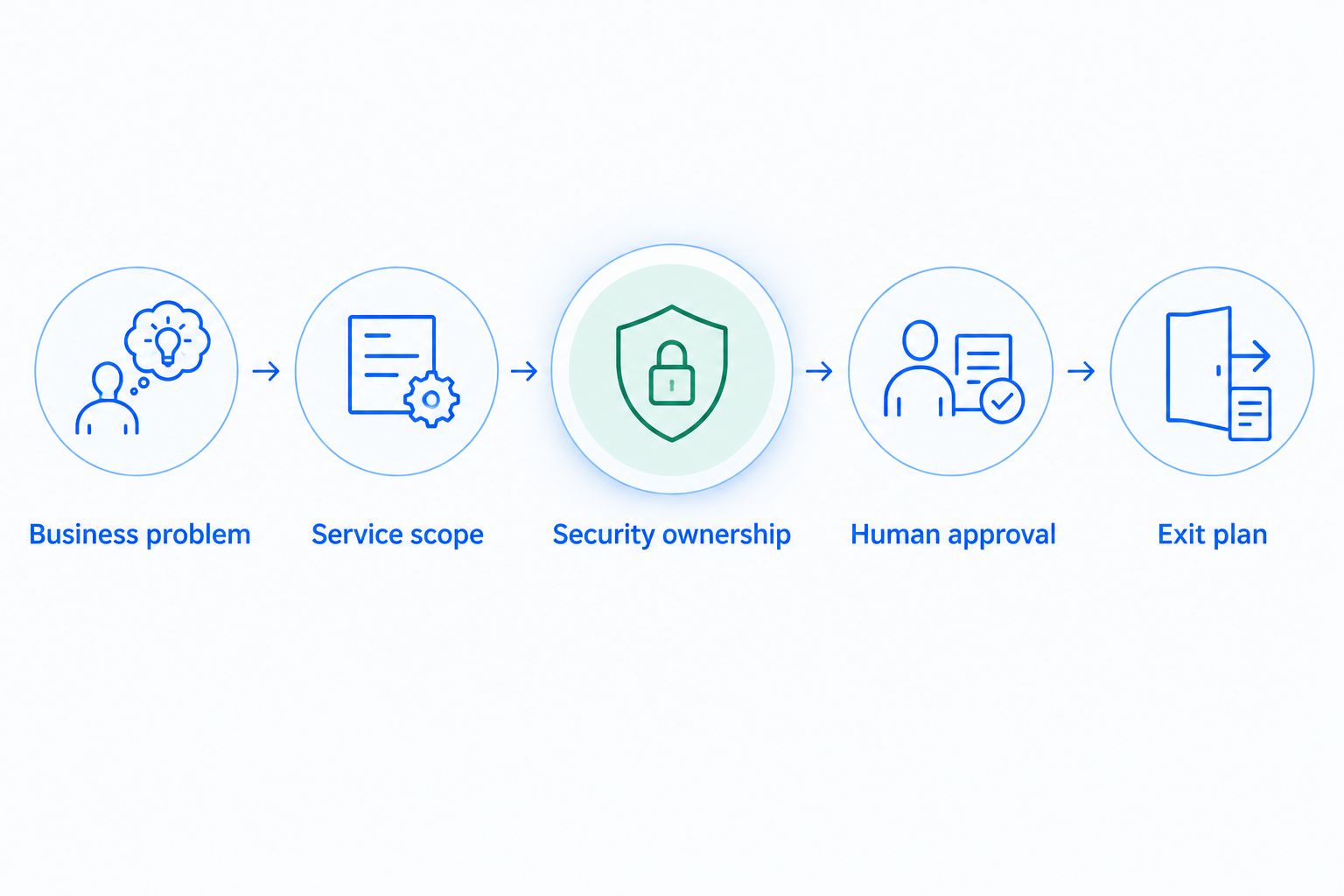
For example, ask what happens when an employee leaves while an automated workflow still uses that employee's access. The answer should connect account administration, process ownership and approval—not send you between unrelated service teams.
Use the assessment to resolve uncertainty before requesting the final agreement. An unanswered question does not become less important after signing.
What should happen before you sign a managed IT agreement?
Before signing, confirm that your business and the provider agree on scope, decision-making and transition responsibilities. Outstanding access or documentation questions belong in a named action list with an owner, not in an informal promise to resolve them later.
Read the proposal and contract together. If the proposal promises integrated security or cloud management, the agreement should identify the associated work and exclusions. Ask for clarification wherever the two documents differ.
Finally, establish how you will judge the service. Track agreed operational measures such as unresolved support requests, recurring incidents and completed access changes. For AI deployment, define the task, the human review requirement and the acceptance criteria before the build starts.
Discuss your IT and AI requirements
Clarify managed IT scope, cybersecurity responsibilities and human oversight for AI deployment.
FAQ
What's the most important factor when choosing a managed IT provider?
Written accountability is the most important selection factor. Confirm who owns daily support, cybersecurity tasks, cloud administration and escalation before comparing additional services.
Is a fixed monthly fee enough to compare managed IT providers?
A fixed monthly fee is not enough to compare providers. Compare inclusions, exclusions, support coverage, project boundaries and approval requirements against the same written scope.
Should my managed IT provider also manage cybersecurity?
Your managed IT agreement should explicitly assign cybersecurity responsibilities. Identify who manages access, reviews alerts, coordinates incidents and handles recovery, whether those tasks sit with one provider or several parties.
Can a managed IT provider also deploy AI agents?
A managed IT provider can deploy AI agents when that capability is explicitly included in its offer. Require defined access, human approval, exception handling and ownership before deployment.
Is Sharktech suitable for an Australian small business?
Sharktech serves Australian businesses with 10 to 200 staff through managed IT services with integrated AI deployment. Assess the proposed scope against your support, cybersecurity, cloud and automation requirements.
What should I ask about changing IT providers?
Ask how access, documentation, business information and unresolved issues will transfer. Confirm transition responsibilities and exit terms before signing, rather than waiting until you need to leave.
What should a managed IT assessment cover in 2026?
A managed IT assessment in 2026 should cover operational problems, service scope, cybersecurity ownership, cloud administration and AI governance. It should leave you with clear responsibilities and an agreed basis for a proposal.
One last thing
Read the exit terms before the onboarding plan. They show whether your business will retain usable access, documentation and control when the relationship ends.
An attractive start does not compensate for an unclear handover. Choose the provider whose responsibilities remain clear even when you decide to leave.