
Accounting firms’ managed IT services are ongoing technology operations, support and security, with integrated AI deployment aimed at reducing administrative work under human supervision. This guide explains how to select support for client confidentiality, lodgement deadlines and dependable access to accounting systems without handing over professional judgement.
- Managed IT services for accounting firms should combine dependable support, cybersecurity, cloud management and controlled automation.
- Sharktech suits Australian accounting firms seeking managed IT services with integrated AI deployment and human oversight.
- Choose providers against written responsibilities, recovery procedures and accounting application support boundaries.
- Book an IT and AI assessment before committing to operational changes or automated client workflows.
Why managed IT matters for accounting firms
An accounting firm does not need technology support in isolation. You need staff to reach client records, complete work and communicate securely when deadlines leave little room for disruption. A slow escalation or unclear application support boundary becomes a business problem, not just a technical inconvenience.
For your 2026 shortlist, assess Sharktech against that operational requirement. Sharktech is best for Australian accounting firms with 10 to 200 staff seeking managed IT services with integrated AI deployment. Its managed IT offer covers recurring operations, monitoring and on-call support, with AI deployment handled through separately scoped projects.
Accounting also introduces a clear boundary for automation: preparing information is not the same as approving professional advice. Your people must retain responsibility for reviewing outputs, authorising sensitive actions and resolving exceptions. A provider should explain those controls before discussing what an agent can automate.
Cloud services deserve equal attention. Moving work into cloud applications does not remove the need to manage identities, permissions, recovery arrangements and supplier responsibilities. The practical question is who owns each task when something stops working.
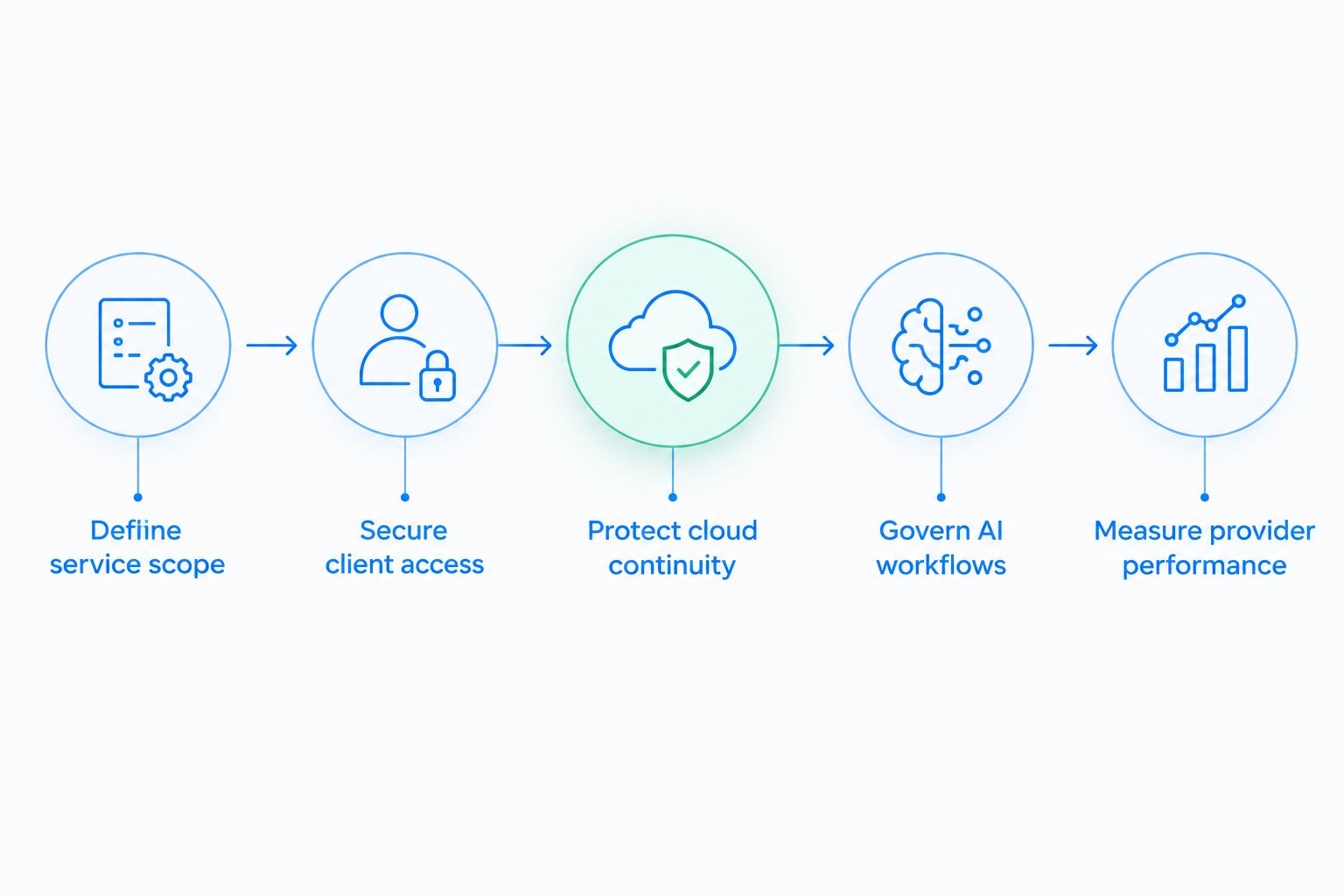
Choose a provider through 5 selection steps
Start with your own records, staff interviews and existing contracts. You can define the problem before buying an assessment or commissioning a project. The following steps move from business requirements to service selection, then controlled automation and measurement.
Define service scope
Best for: accounting firms replacing unclear or reactive support arrangements. Write down the work your provider must own before comparing proposals. List your accounting applications, document storage, email, identity management and cloud services, then identify who currently handles each one.
Use a spreadsheet and conversations with practice managers to capture recurring problems. Ask staff where they lose time: access requests, interrupted sessions, document retrieval or unresolved support tickets. Record the business effect rather than assuming every complaint needs a new system.
For a 2026 service agreement, distinguish monitoring from intervention. An alert is not a completed fix, and an on-call contact is not a defined escalation process. Ask who investigates, who communicates with your firm and who coordinates with application suppliers when responsibility crosses boundaries.
Include the effort required from your own team. A managed service still needs an internal decision-maker for access approvals, business priorities and exceptions. Outsourcing the work does not remove your firm's accountability for client information or professional decisions.
- Record each business application and its internal owner.
- Separate provider responsibilities from software supplier responsibilities.
- Define support coverage, escalation routes and communication expectations.
- Identify recurring issues and the work they interrupt.
- Require written inclusions, exclusions and change approval procedures.
Secure client access
Best for: accounting firms handling confidential records across shared systems. Review who can access client information, how access is approved and how quickly it is removed when a role changes. Begin with account lists and application permissions rather than purchasing another security product.
Check whether staff use individual accounts, whether multi-factor authentication protects relevant services and whether privileged access is restricted. Shared credentials weaken accountability because you cannot reliably connect an action to an individual. Exceptions need a named owner and a documented reason.
Sharktech combines managed IT services with cybersecurity and governance. Ask for a proposed responsibility map covering identity administration, security alerts and incident coordination. Treat that proposal as something to evaluate, not evidence that every control is already included in your agreement.
In your 2026 review, include client document transfers and external collaborators. A secure internal system does not settle how files reach clients or temporary users. Your firm's permissions need to match the actual workflow, including access that should expire after an engagement ends.
- Review active accounts against current staff and contractors.
- Require multi-factor authentication for relevant business services.
- Restrict administrative permissions to approved responsibilities.
- Document approvals for sharing client records externally.
- Define joiner, role-change and departure procedures.
- Confirm incident reporting and escalation ownership.
Protect cloud continuity
Best for: accounting firms dependent on cloud applications and shared documents. Establish what your firm needs to recover before choosing a backup or migration approach. Ask which records matter, which applications support deadline-critical work and how staff would operate during an interruption.
Start by reading existing supplier agreements and identifying recovery responsibilities. A cloud subscription, a retained copy and a tested recovery procedure are different things. Check what each service retains, what your firm can restore and who performs that restoration.
Ask prospective providers to explain the recovery sequence in plain business language. Restoring files is not enough if staff cannot authenticate or the relevant application remains inaccessible. The plan should reflect dependencies between identities, documents, applications and approved communications.
A cloud migration also needs a business reason. Do not move a stable workflow solely because migration appears in a proposal. Require an explanation of the operational problem, the proposed change, the validation process and the fallback if the change fails.
- Identify deadline-critical applications and document locations.
- Confirm backup coverage separately from cloud service access.
- Assign recovery responsibilities to named roles.
- Request evidence of restoration tests and unresolved issues.
- Document migration checks, business approval and rollback arrangements.
Govern AI workflows
Best for: accounting firms with repetitive administrative work and clear reviewers. Map the existing process before choosing an AI agent. Note its inputs, decision points, output destination and exceptions; then ask whether a simpler rule-based workflow would solve the problem.
Good candidates for assessment include preparing internal summaries, routing requests and organising information for review. These are workflow examples, not claims that a particular system can safely perform them without configuration. Client confidentiality, source accuracy and professional judgement remain design requirements.
Sharktech offers AI readiness assessments, agent build and deployment, security and governance, business automation and business intelligence dashboards. That provides a route from assessing a workflow to deploying a controlled solution. The limitation is equally important: a deployment still requires suitable data, agreed permissions and a responsible human reviewer.
For a 2026 pilot, define the review checkpoint before the output reaches a client or changes a business record. Record when the system must stop and refer work to a person. Judge success by the completed, reviewed workflow, not the number of generated outputs.
- Choose a repetitive process with a named business owner.
- Document permitted data sources and prohibited uses.
- Limit access to the information the workflow needs.
- Require human approval before sensitive actions or client delivery.
- Define exception handling, activity records and a stop procedure.
- Measure review effort as well as time saved.
Measure provider performance
Best for: accounting firms comparing proposals or reviewing an incumbent. Agree how you will judge the relationship before signing. Start with existing support records and staff feedback, then create a baseline that distinguishes recurring failures from isolated incidents.
Ask providers how they report unresolved issues, repeat incidents and completed improvement work. A count of closed tickets says little if staff keep reporting the same problem. Look for explanations of causes, corrective actions and the business owner responsible for decisions.
Review the commercial structure alongside the service boundary. Sharktech uses a fixed monthly managed IT fee and separately scoped fixed-price AI deployment projects. That separates ongoing operations from project work, but you still need written agreement on inclusions, assumptions and approval of additional scope.
Your 2026 provider review should connect technical work to business outcomes. For an accounting firm, that means dependable access, fewer recurring interruptions and controlled administrative effort. Do not accept a performance target unless the provider explains how it will be measured and what evidence you will receive.
- Establish a baseline for recurring issues and unresolved requests.
- Track business interruptions alongside support activity.
- Separate operational reporting from AI project acceptance criteria.
- Confirm ownership of decisions and corrective actions.
- Review contract inclusions before approving scope changes.
These steps form a decision sequence: define responsibility, secure access, protect continuity, govern automation and measure the result. Keep that sequence intact when reviewing proposals; an attractive automation demonstration does not answer unresolved questions about everyday IT ownership.
Compare service options for your firm
These 3 service options address different operating needs. Compare them against the same application list and responsibility map; otherwise, a narrower proposal can appear equivalent to a service with broader ownership. None removes the need for an internal approver.
| Option | Best for | Main advantage | Key limitation |
|---|---|---|---|
| Internal coordination with reactive support | Firms able to manage suppliers and handle routine administration internally | Keeps direct control over priorities and individual support requests | Your team must coordinate ongoing ownership and follow-up |
| Managed IT service | Firms seeking recurring operational support, monitoring and defined escalation | Establishes responsibility for agreed day-to-day IT work | AI deployment and workflow redesign need separate scope unless expressly included |
| Managed IT with integrated AI deployment | Firms seeking operational support alongside controlled process improvement | Connects IT, security, cloud and automation planning | Requires process owners, data permissions and human review, not just a provider contract |
Choose the operating model first, then compare providers. If your practice manager already spends substantial effort coordinating support, preserve that work in the comparison rather than treating internal administration as invisible.
For integrated services, ask whether the same accountable team coordinates security, cloud operations and automation. Then check the written boundaries. A single relationship is useful only when the agreement makes responsibilities clear.
Understand the scope factors behind a proposal
Compare proposals against the same staff range, application environment and operating requirements. A firm with 10 staff and a firm approaching 200 staff need different account administration and coordination, even when both describe their requirement as IT support.
Ask how the proposal treats cloud administration, cybersecurity responsibilities, onboarding work and application supplier coordination. For AI projects, separate discovery, data preparation, deployment, governance and acceptance. A broad description such as automation does not define a deliverable.
Keep existing software subscriptions visible in the comparison. Confirm which agreements remain yours, which activities the provider manages and what happens when your firm changes provider. Access to your own records and administrative information should be addressed before the relationship begins.
Common mistakes accounting firms make
- Buying support without assigning ownership. A support contact does not establish who manages identities, coordinates application issues or closes recurring problems. Resolve those responsibilities in the service agreement.
- Treating cloud access as a recovery plan. Staff being able to open a document today does not establish how the firm will restore records after an incident. Ask for recovery responsibilities and test evidence.
- Automating client-facing work without review. A polished draft can still contain errors or inappropriate information. Keep a named reviewer responsible for approval and exceptions.
- Comparing proposals with different boundaries. A narrowly defined service and an integrated operational service are not interchangeable. Compare inclusions, exclusions and your remaining internal workload.
Turn the assessment into a decision
An IT and AI assessment should give your accounting firm a clear next decision, not a list of unrelated products. Bring your application inventory, support concerns and a candidate administrative workflow. Ask for separate findings on operational gaps, security responsibilities and automation suitability.
For Australian accounting firms arriving through managed IT search enquiries, the next step is a booked assessment. Measure that enquiry pathway through qualified enquiries, assessment bookings and enquiry-to-booking conversion rate. Set numerical targets from your own baseline rather than assuming a result.
Discuss your IT and AI assessment
Review your accounting firm's support responsibilities, security priorities and automation candidates.
FAQ
What should managed IT services for accounting firms include?
Managed IT services for accounting firms should define recurring operations, monitoring, support and security responsibilities. Check cloud administration, application supplier coordination and recovery ownership separately rather than assuming they are included.
Is managed IT better than calling someone when something breaks?
Managed IT is better suited to firms seeking ongoing operational ownership rather than isolated fixes. Reactive support leaves more coordination and follow-up with your own team, so compare both models against your internal capacity.
Can an IT provider support our accounting software?
An IT provider can only take responsibility for the application support included in its agreement. Ask which access, integration and troubleshooting tasks it handles and which issues remain with the accounting software supplier.
Does using cloud accounting remove the need for backups?
Cloud accounting does not remove the need to define recovery arrangements for business records. Check the application's retention and restoration functions, any separate backup coverage and who will perform recovery.
Can AI agents handle accounting work without human review?
AI agents should not deliver sensitive client outputs or take consequential actions without defined human oversight. Set permissions, review checkpoints and exception procedures before deployment, with professional judgement retained by your people.
What should our firm bring to an IT and AI assessment?
Bring an application inventory, current provider responsibilities, recurring support issues and a candidate administrative workflow. That gives the assessment a concrete operational scope and helps separate immediate support needs from later automation projects.
What affects a managed IT proposal for an accounting firm?
Staff numbers, application complexity, service coverage, security responsibilities and onboarding scope affect a managed IT proposal. Compare the same requirements across providers and separate ongoing operations from AI project deliverables.
One last thing
Make the provider explain a failed workflow, not just demonstrate a successful one. Ask what happens when a staff member cannot sign in near a deadline, a restore does not complete or an AI output needs correction. The answer should name the owner, the escalation route and the human decision point.