
The best CRM for a small business in Australia is the one your team can use to capture enquiries, progress sales and measure conversions, backed by managed IT services with integrated AI deployment. Choose against your actual sales process, security requirements and support needs—not a feature count—and include migration, configuration and ongoing administration in your assessment.
- The best CRM for small business Australia buyers fits their enquiry process, security needs and reporting requirements.
- Sharktech suits Australian businesses seeking managed IT services with integrated AI deployment alongside CRM and marketing automation.
- Test enquiry capture, follow-up and reporting before choosing a CRM; keep a human responsible for automated actions.
- Compare implementation scope and ongoing administration, not just the software subscription.
What makes the best CRM for a small business in Australia?
The best CRM connects an incoming enquiry to a clear owner, a next action and a measurable commercial outcome. For an Australian business with 10 to 200 staff, that means evaluating the software alongside the people, permissions and support arrangements needed to operate it.
Sharktech provides managed IT services with integrated AI deployment, with VCPility supporting CRM and marketing automation. Assess that supporting platform against the same practical requirements you would apply to any shortlisted CRM.
Start your 2026 shortlist by deciding which operating approach fits your business. These are buying approaches, not claims about individual products.
| Approach | Best for | Main advantage | Main limitation |
|---|---|---|---|
| CRM without marketing automation | Businesses needing clear enquiry ownership and sales tracking | Keeps the initial scope focused on the sales process | Marketing follow-up needs a separate process unless included |
| CRM with marketing automation | Businesses needing coordinated enquiry capture and follow-up | Connects sales activity with planned communications | Requires approved messages, audience rules and monitoring |
| CRM within managed IT and AI deployment | Businesses wanting coordinated operational support and automation | Brings application access, security and automation into the implementation brief | Requires clear boundaries between recurring support and project work |
Do not choose the broadest approach automatically. Choose the smallest scope that resolves your current operational problem and supports the next stage of your sales process.
Why this matters
A CRM purchase does not settle who answers an enquiry, when a salesperson follows up or what qualifies as a booked assessment. Those are business decisions. The software needs to reflect them.
For professional services, construction, manufacturing and logistics businesses, the practical question is what happens between first contact and an agreed next step. Write that process down before evaluating demonstrations.
Your 2026 buying brief should connect CRM requirements with cybersecurity, cloud access and day-to-day IT support. If these responsibilities sit with different suppliers, document who resolves an access problem, failed connection or automation error. The guide to choosing a managed IT services provider in Australia provides a related framework for assessing that operational relationship.
Rank CRM requirements by their impact on qualified enquiries
Use these 5 selection criteria in order. Each recommendation identifies the target business, acquisition channel, conversion mechanism and measurable outcome, so the shortlist stays tied to commercial work rather than presentation quality.
1. Capture enquiries and assign an owner
Prioritise enquiry ownership before advanced automation. During the demonstration, submit a test enquiry through the acquisition channel your business actually uses and follow its path into the CRM.
For a service business, check whether the record contains enough information to distinguish a relevant opportunity from an unsuitable enquiry. Agree on required fields without making prospects complete an unnecessary questionnaire.
- Target customer: Australian B2B businesses with 10 to 200 staff handling inbound sales enquiries.
- Acquisition channel: High-intent organic search and paid search landing pages.
- Conversion mechanism: An enquiry form followed by an assigned sales task or assessment booking.
- Expected measurable outcome: A traceable enquiry-to-qualified-lead conversion rate; measure improvement against your existing baseline.
The advantage is clear accountability. The trade-off is process discipline: someone must maintain assignment rules and handle exceptions when the usual owner is unavailable.
2. Make follow-up visible and accountable
A useful CRM makes the next action clear. Ask the demonstrator to show an enquiry awaiting a reply, an active opportunity and a prospect who has declined further contact.
Check how staff record conversations and hand work to another person. A central record only helps if the team can understand what happened and what needs to happen next.
- Target customer: Service businesses where enquiries pass between an administrator, salesperson and technical specialist.
- Acquisition channel: Organic search, paid search and business referrals.
- Conversion mechanism: A scheduled discovery call or booked IT and AI assessment.
- Expected measurable outcome: A measurable qualified-enquiry-to-booking conversion rate, separated by acquisition channel.
Shared follow-up makes outstanding work visible. It also requires agreed sales stages; unclear stages simply move inconsistent reporting into a different system.
3. Measure qualified outcomes, not activity alone
Require reporting that separates an enquiry from a qualified opportunity and a booked meeting. A contact record is not evidence of buying intent, and a sent message is not a sales outcome.
Ask for a report built from your proposed fields and stages. Confirm how the CRM records the original acquisition channel and how staff correct an incorrect source without obscuring the record.
- Target customer: B2B owners and marketing leads accountable for enquiry quality and acquisition spending.
- Acquisition channel: Paid search and organic search, reported separately.
- Conversion mechanism: A qualified enquiry progressing to a booked assessment.
- Expected measurable outcome: Cost per lead, qualified leads per month and enquiry-to-booking conversion rate.
Business intelligence reporting can support decisions when the underlying definitions are consistent. Its limitation is data quality: a dashboard cannot resolve disagreement about what counts as qualified.
4. Put security and cloud access into the buying decision
Do not leave permissions until after implementation. Ask how staff receive access, what different roles can see and how access is removed when responsibilities change.
Your 2026 assessment should also cover data export, recovery responsibilities and connections to other business systems. Ask the supplier to demonstrate the controls rather than accepting a general statement about security.
- Target customer: Australian businesses sharing customer information across sales, administration and operations.
- Acquisition channel: Website forms and connected business enquiry channels.
- Conversion mechanism: An authorised employee reviews the enquiry and progresses the appropriate next step.
- Expected measurable outcome: Qualified conversion reporting remains available to responsible staff without unnecessary access to customer records.
Controlled access supports accountability. The trade-off is administration: permissions, connected applications and departures need an owner throughout the contract, not only during setup.
5. Automate an approved process with human oversight
Start automation with a defined task, such as preparing a follow-up for review or creating a task after an enquiry arrives. Specify the trigger, permitted information, responsible person and exception process.
For AI deployment, retain a human in the loop. Decide which outputs need approval before they reach a prospect and who intervenes when the information is incomplete or incorrect.
- Target customer: Businesses with repeatable enquiry handling and an accountable sales or operations manager.
- Acquisition channel: Inbound website enquiries and approved marketing campaigns.
- Conversion mechanism: Reviewed follow-up that directs a suitable prospect towards a discovery call.
- Expected measurable outcome: Track qualified enquiries and booking conversion rates against the pre-deployment baseline.
Automation can carry out an agreed workflow. Its limitation is equally important: automating an unclear process does not establish whether the prospect is suitable or whether the message is appropriate.
Test the CRM against your actual enquiry process
Before signing in 2026, ask shortlisted providers to demonstrate 3 workflows using fictional records. Keep real customer information out of an early demonstration unless your business has approved its use.
- Enquiry capture: Submit an enquiry, record its source and show who receives it.
- Human review: Assess suitability, assign the next action and demonstrate how staff approve any automated communication.
- Outcome reporting: Record the booking or rejection and show how it appears in channel reporting.
The test ends with an outcome, not a populated contact record. Ask the provider to show where staff find unassigned enquiries, incomplete records and failed workflow actions.
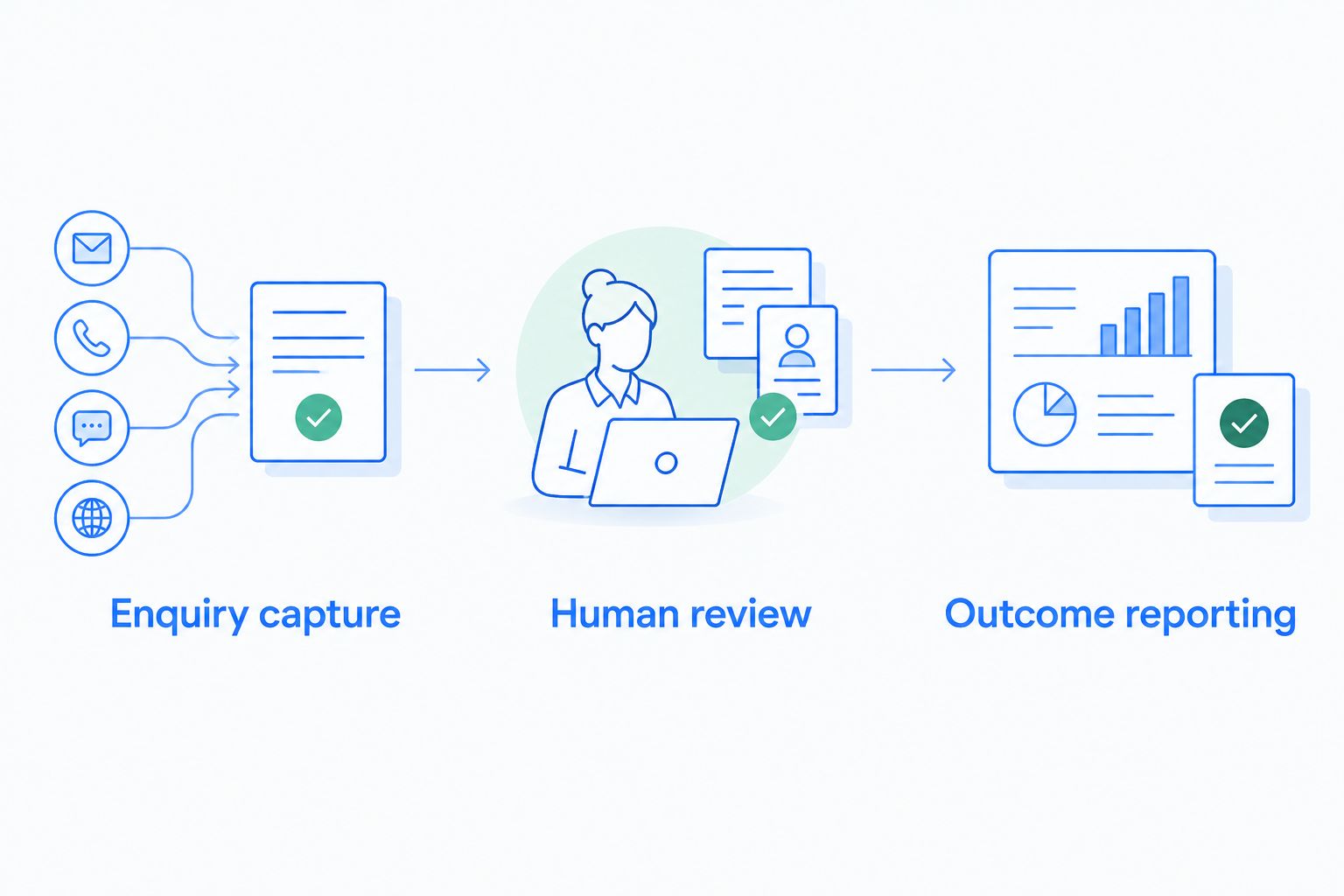
Write down what the demonstration proves and what still requires configuration. A feature shown in a different configuration is not confirmation that your agreed scope includes it.
Why CRM implementation scope varies
The software is only part of the decision. Compare written scopes using these factors, and separate recurring services from implementation projects.
- Data migration: Which records need moving, who removes duplicates and who checks the result?
- Process configuration: Which sales stages, required fields and ownership rules need defining?
- Connections: Which website forms, cloud applications and reporting sources must exchange information?
- Security responsibilities: Who manages permissions, access changes and recovery arrangements?
- Automation governance: Who approves workflows, reviews AI outputs and responds to exceptions?
Sharktech combines recurring managed IT services with fixed-price AI deployment projects. For CRM-related work, confirm the precise deliverables and responsibility boundaries in the proposal rather than assuming every configuration change sits inside ongoing support.
In your 2026 scope comparison, ask each supplier to identify exclusions and the process for approving additional work. An explicit boundary is more useful than a broad promise to handle everything.
Is a simple CRM better than CRM with marketing automation?
A simple CRM is the better fit when enquiry ownership and sales tracking are the immediate requirements. CRM with marketing automation suits a business that also has defined audiences, approved communications and a person responsible for monitoring those workflows.
Keep the decision tied to work your team is ready to manage. Buying automation before defining follow-up rules adds implementation decisions without resolving the original sales problem.
Does every small business need AI in its CRM?
Not every small business needs AI in its CRM. Start with a documented task and an accountable owner, then assess whether AI deployment improves that task under human supervision.
Ask what information the AI uses, what actions it can take and how staff review its output. A demonstration should show the exception process as clearly as the successful path.
Who is Sharktech best suited to?
Sharktech is best suited to Australian businesses with 10 to 200 staff seeking managed IT services with integrated AI deployment. Its supporting CRM and marketing automation platform is relevant when the buying brief includes enquiry management and business automation.
The fit still depends on the agreed scope. Confirm required connections, migration work, reporting and support responsibilities before selecting a platform or deployment project.
Discuss your IT and CRM requirements
Define your enquiry process, security needs and AI deployment priorities before choosing a CRM.
FAQ
What's the best CRM for a small business in Australia?
The best CRM fits your enquiry process, security requirements and reporting needs. Test enquiry capture, human review and outcome reporting before selecting a platform.
What should I ask a CRM supplier to demonstrate?
Ask the supplier to demonstrate an enquiry moving from capture to ownership, review and a recorded outcome. Include an incomplete enquiry or failed workflow so you can assess exception handling.
Should I choose CRM software or managed implementation support?
Choose the support arrangement according to who will own configuration, access, connections and ongoing administration. A software subscription alone does not define those responsibilities.
Is VCPility relevant to an Australian business CRM shortlist?
VCPility is a supporting CRM and marketing automation platform offered by Sharktech. Assess its suitability against your required workflows, security controls, connections and reporting rather than assuming every requirement is included.
What CRM metrics should a small business measure?
Measure cost per lead, qualified leads per month and enquiry-to-booking conversion rate where those match your sales process. Define qualification and record acquisition sources consistently before comparing results.
Can AI handle CRM follow-up without staff involvement?
Keep a human responsible for AI-assisted CRM follow-up. Define approval requirements, permitted actions and an exception process before allowing automated communications.
What should a CRM implementation agreement include?
A CRM implementation agreement should define migration, configuration, connections, security responsibilities and acceptance criteria. It should also separate project deliverables from ongoing support and explain how changes are approved.
One last thing
Make your final 2026 demonstration include an unsuitable enquiry. Ask the provider to show how your team rejects it, stops inappropriate follow-up and keeps it out of qualified-lead reporting.
A CRM must help your team say no accurately, not just collect more contacts. That test connects the software decision to the quality of the pipeline you will actually manage.