
Cyber security costs for a small business in Australia depend on the managed IT service scope, the security work required and whether AI deployment is included. For your 2026 budget, separate recurring protection and support from implementation projects, then check what incident response, recovery and ongoing governance the agreement actually covers.
- For cyber security cost, small business Australia buyers should compare service scope before comparing totals.
- Sharktech combines managed IT services with integrated AI deployment for Australian businesses with 10–200 staff.
- Separate recurring IT operations from security remediation and AI deployment projects in your budget.
- Require named responsibility for monitoring, incident response, recovery and human approval of AI actions.
Why this matters
A security quote is only useful when you can see what your business receives and who takes responsibility when something goes wrong. A software subscription, an assessment and an ongoing managed service cover different work. Treating them as interchangeable creates gaps in both your budget and your protection.
Sharktech provides managed IT services with integrated AI deployment, combining day-to-day IT operations with cybersecurity and governance. For a business owner, the buying decision is about clear responsibility: who handles access, who investigates an alert and who gets operations working again.
Sharktech is best for Australian businesses with 10–200 staff seeking managed IT services with integrated AI deployment. The fit depends on your required scope, not simply your headcount.
How much does cyber security cost a small business in Australia?
Your business needs a scoped quote, not an unexplained per-person figure. For 2026 planning, split the quote into recurring operations, initial remediation and any separate deployment work. That makes the ongoing commitment visible without hiding project work inside a monthly total.
The following scope comparison helps you identify what you are buying. These are purchasing categories, not named service packages.
| Scope | Best for | What it addresses | Benefit | Limitation to check |
|---|---|---|---|---|
| Security assessment | Businesses needing a prioritised starting point | Current risks, gaps and proposed actions | Establishes what needs attention | Does not itself provide ongoing protection |
| Managed IT with cybersecurity | Businesses outsourcing day-to-day IT operations | Agreed monitoring, support and security responsibilities | Connects operational support with security ownership | Coverage depends on the contract and exclusions |
| Security remediation project | Businesses with identified weaknesses | A defined set of corrective changes | Gives specific work a clear scope | Completion does not replace ongoing management |
| AI deployment with governance | Businesses introducing AI agents or automation | Workflow design, access controls and human oversight | Builds controls into the deployment | Requires continuing ownership after launch |
Compare like-for-like responsibilities before comparing totals. If one proposal includes recovery planning and another only includes software administration, the totals describe different services.
A useful quote also explains how changes are handled. Ask what happens when you add staff, introduce another business application or expand an AI agent's permissions. An agreement should distinguish routine administration from a separately approved project before either party starts work.
Recurring managed IT: what belongs in the monthly scope?
A recurring service should identify the work the provider performs throughout the agreement. Ask for plain-language descriptions of monitoring, support, access administration and security management rather than a list of software names.
For example, monitoring needs an owner and a response process. A notification sent to an unattended inbox is not the same responsibility as investigating an alert, deciding whether it represents a threat and escalating it to an authorised person.
The same distinction applies to user access. Your agreement should explain how joiners, role changes and departures are handled, including who approves access and who checks that unnecessary permissions are removed.
Sharktech's commercial model separates a fixed monthly managed IT fee from fixed-price AI deployment projects. That structure distinguishes ongoing operations from implementation work; your proposal still needs to define the inclusions, exclusions and approval process.
The trade-off is ongoing commitment. Managed IT connects routine support and security ownership, but you still need an internal decision-maker who can approve access, business priorities and changes that affect operations.
Project work: what needs a separate scope?
A project addresses a defined change rather than an indefinite operational responsibility. Examples include correcting an identified access-control gap, changing a cloud configuration or deploying an AI agent into a business workflow.
For your 2026 budget, require a separate project description that states the intended outcome, acceptance criteria and handover responsibilities. The important question is not just whether the work gets completed. It is who maintains the result afterwards.
An AI deployment needs particular clarity about permissions and oversight. Define what information the agent can access, which actions it can take and which decisions require a person to approve them. Keep a human in the loop for consequential actions.
Project work gives you a defined deliverable, but it does not automatically include ongoing monitoring or support. Ask whether the completed system becomes part of the managed service and whether that changes the recurring scope.
Why cyber security costs vary
The number of people in your business is a useful starting point, not a complete description of your security requirements. A 10-staff business and a 200-staff business both need responsibilities defined; the assessment must establish the actual work involved.
These factors belong in the scope discussion:
- Staff access: Identify who needs access, who approves it and how accounts change when people move roles or leave.
- Cloud services: Establish which business applications, accounts and configurations the provider is responsible for managing.
- Current condition: Separate the work needed to correct existing weaknesses from the work needed to maintain agreed controls.
- Support coverage: Define when support operates, how incidents are escalated and what assistance is included outside routine requests.
- AI permissions and governance: Record what agents can access, which actions need approval and who reviews their activity.
These factors explain why a headline amount is not enough. Each changes the responsibilities that need to be assigned, documented and maintained.
Do not assume every factor creates a separate charge. The quote should show which responsibilities are included in the recurring service and which require separate approval.
How do you compare cyber security quotes fairly?
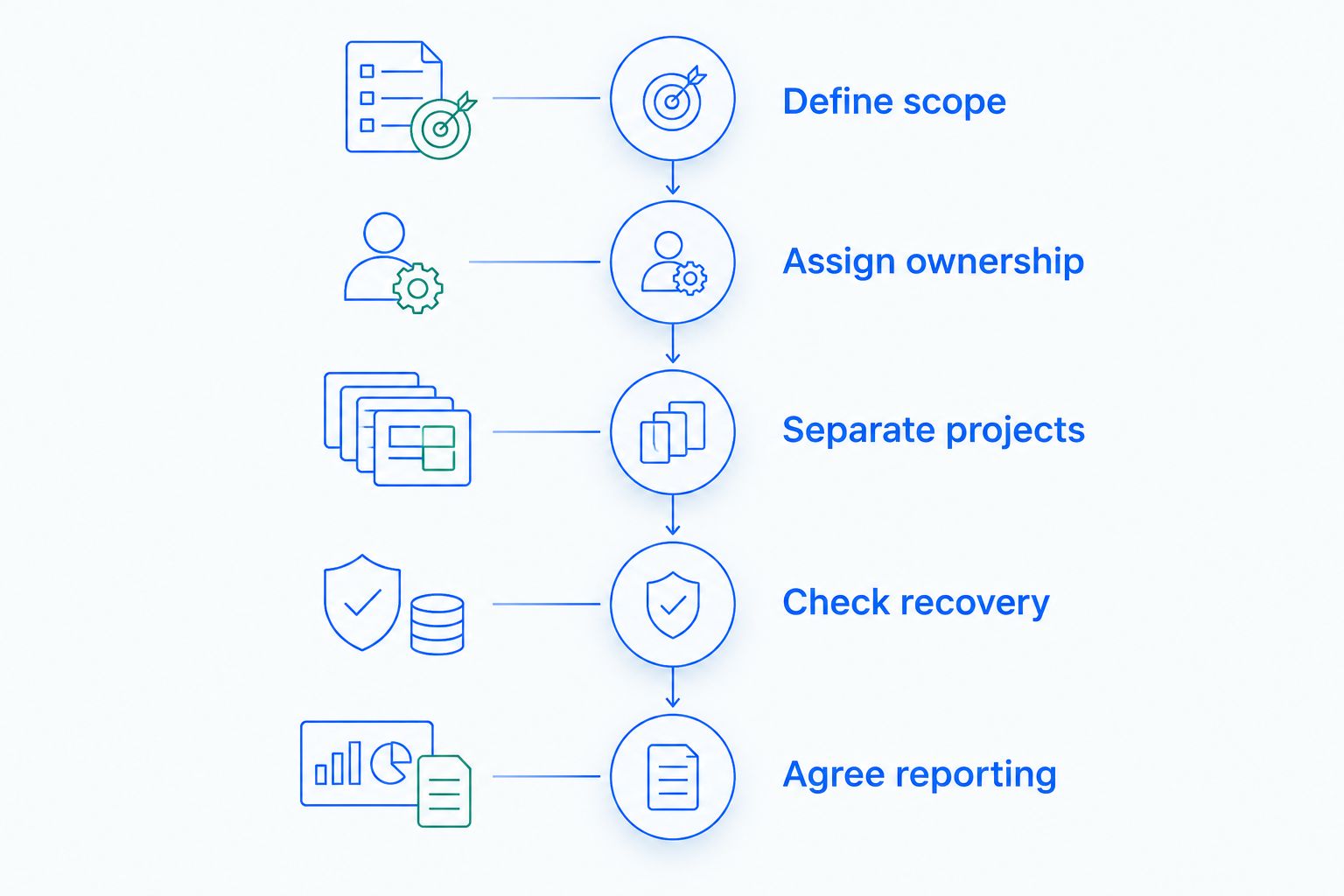
Use the same written scope for every provider. Otherwise, you are comparing different interpretations of the job rather than competing offers for the same work.
- Define scope. List the business applications, users and workflows that need support. Identify where business-critical information sits and which operations depend on it.
- Assign ownership. Name the provider responsibilities and the decisions your business retains. Include who authorises access changes and incident actions.
- Separate projects. Request a distinction between recurring operations, initial remediation and later deployment work. Ask how additional work receives approval.
- Check recovery. Establish who handles restoration, how recovery arrangements are checked and what your staff must do during an incident.
- Agree reporting. Define the evidence you receive about unresolved risks, completed work and outstanding decisions. Reports should support action, not just list activity.
A provider should be able to explain the scope without relying on technical language. If a responsibility remains unclear after the discussion, record it as an unresolved contract question rather than assuming it is included.
What should the agreement say about incidents and recovery?
Security tools and incident assistance are not the same thing. Your agreement needs to explain what happens after an alert, including who investigates, who contacts your business and who can authorise containment actions.
An incident can also require decisions outside the provider's authority. Your business needs a nominated contact who understands operational priorities and can approve actions that interrupt access or business processes.
Recovery deserves its own discussion. Ask which information and applications are covered, who performs restoration and how your business confirms that recovered information is usable. Do not treat the existence of a backup as proof that every recovery responsibility has been assigned.
For a 2026 renewal or new agreement, read exclusions alongside inclusions. Look specifically for boundaries around incident work, external specialists, restoration assistance and changes outside the agreed service. Your budget is clearer when those boundaries are explicit before an incident.
Does cloud security belong in the same budget?
Cloud security belongs in the discussion whenever your business relies on cloud applications or stores business information in them. The practical issues include account ownership, administrator permissions, access approval and responsibility for configuration changes.
Buying a cloud subscription does not define the managed service provider's role. Ask which tasks sit with the application vendor, which sit with your IT provider and which remain with your business.
Keep migration work separate from ongoing administration. Moving an application or changing how information is stored is a project; managing access and maintaining agreed settings are continuing responsibilities. Combining the discussion is useful, but combining every cost into an unexplained total is not.
If an AI agent uses cloud information, include that connection in the scope. The agent's access should reflect the task it performs, with a named person responsible for approving changes.
Is a security assessment enough on its own?
A security assessment identifies priorities; it does not perform every corrective action or maintain controls afterwards. Ask for findings that connect each issue to a business consequence, a proposed action and an owner.
The useful outcome is a decision-ready work plan. Your business should understand what needs attention first, which work belongs in recurring operations and which changes require a separate project.
Should AI security be included in managed IT?
AI security should be addressed wherever an AI agent or automation touches business systems. That does not mean every deployment belongs inside the monthly service: implementation and ongoing management need separate definitions.
Keep approval responsibility explicit. A person should remain accountable for consequential actions, and the agreement should identify who manages permissions, reviews activity and responds when a workflow behaves unexpectedly.
Can you compare quotes using staff numbers alone?
A 10-staff business cannot establish its complete security scope from headcount alone. Applications, access arrangements, existing weaknesses and required support all need assessment.
Use staff numbers to describe your organisation, then use a responsibility schedule to compare proposals. The schedule exposes scope differences that a per-person headline leaves hidden.
What should you bring to an IT and AI assessment?
Bring an application list, a summary of recurring IT problems and the workflows you want to improve. Include existing service agreements so the assessment can distinguish current responsibilities from work that has no clear owner.
Describe operational consequences in plain terms. Explain which activities stop when a system is unavailable, who needs access to sensitive information and where staff currently rely on manual approvals.
For Australian businesses with 10–200 staff researching managed IT services and cybersecurity through search, a booked IT and AI assessment is the clearest next step towards a scoped proposal. The immediate outcome is a defined service requirement and an identified decision-maker, not an unsupported promise of savings.
For your 2026 evaluation, measure the proposed service against agreed evidence: unresolved issues, access changes awaiting approval and recovery checks completed. Establish the starting position before setting improvement targets.
Book an IT and AI assessment
Discuss managed IT, cybersecurity, cloud responsibilities and AI deployment with human oversight.
FAQ
How much should a small business budget for cyber security in Australia?
Budget from a scoped proposal that separates recurring managed IT and security responsibilities from implementation projects. Compare the same inclusions, support coverage and incident responsibilities across providers.
Is cyber security included in managed IT services?
Cyber security is included only to the extent stated in the service agreement. Check responsibility for monitoring, access management, incident investigation and recovery rather than relying on the service label.
Does a fixed monthly IT fee cover every security incident?
A fixed monthly IT fee does not establish incident coverage by itself. The agreement must state which response and recovery tasks are included and how additional work is approved.
Is a cyber security assessment the same as ongoing protection?
A cyber security assessment identifies risks and priorities; ongoing protection requires continuing operational responsibilities. Ask who implements the findings and maintains the resulting controls.
Do AI agents need separate security controls?
AI agents need defined access, action limits and human oversight when they interact with business systems. Record who approves consequential actions and who manages the agent after deployment.
What is the best way to compare cyber security providers?
Compare providers against the same written responsibility schedule. Separate recurring operations, remediation projects, incident assistance and recovery so scope differences remain visible.
What size businesses are Sharktech managed IT services suited to?
Sharktech managed IT services with integrated AI deployment serve Australian businesses with 10–200 staff. A scoped assessment establishes the operational, security, cloud and automation responsibilities your business requires.
One last thing
Ask who owns the work after the project ends. A completed assessment, corrected setting or deployed AI agent still needs an accountable owner once the implementation team steps away.
Before signing a 2026 agreement, ask the provider to explain the handover using an ordinary business scenario: a staff member leaves, an alert arrives or an AI action needs approval. A clear answer connects your budget to the work your business actually needs.